There is this
and then there is another place outside inside everything
where all the rivers in our hearts empty out
a hummingbird at dawn
a shooting star
in the desert, the bleached bones of a long-dead thing
Leave the glass floor with a gentle push of your bare feet and send yourself into a watercolour cosmos
Tuesday, 17 August 2010


Friday, 13 August 2010
the most beautiful skies as a matter of fact

- Interviewer: "What were the skies like when you were young?"
- Jones: "They went on forever – They - When I w- We lived in Arizona, and the skies always had little fluffy clouds in 'em, and, uh... they were long... and clear and... there were lots of stars at night. And, uh, when it would rain, it would all turn - it- They were beautiful, the most beautiful skies as a matter of fact. Um, the sunsets were purple and red and yellow and on fire, and the clouds would catch the colours everywhere. That's uh, neat 'cause I used to look at them all the time, when I was little. You don't see that. You might still see them in the desert."
- Singing nose flute Rickie Lee Jones recalling picturesque images of her childhood. This was later appropriated without her consent by ambient house troupe The Orb as a sample on dance noodle Little Fluffy Clouds.
Thursday, 12 August 2010
Apricots
I like apples. Apples rarely disappoint. Apples are the Ivan Lendl of the fruit world. Sure, there are some more exciting flavours out there, but are there any that are so consistent? Sure, they can get a bit mealy (they like to be kept in the fridge), and like any tennis players, respond badly to bruising. Most apples are within touching distance of the best apples I've ever eaten (a particularly succulent, crisp and perfumed batch of Spartans which heralded autumn some years back).
Not all fruit are as dependable. There is a massive difference between an early ripening stone fruit, and a full blown mid-summer job, almost ready to explode it is so lusciously ripe. Apricots especially. They can be polite and unassertive, or moderately spectacular. I like dried apricots because they concentrate the sweet sour tang that defines the best of this fruit.
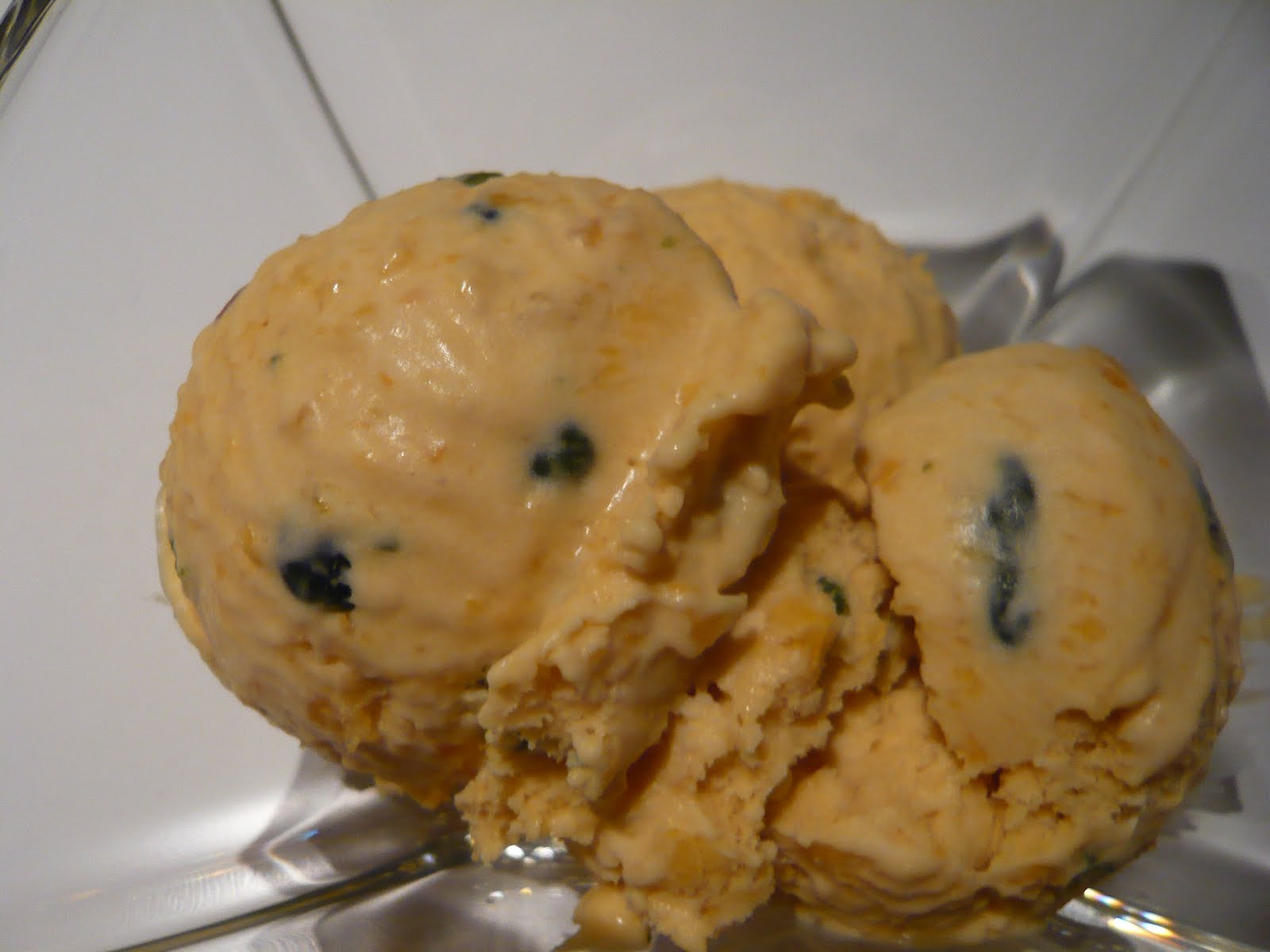
In South Africa, an unusual preserve called mebos is made from ripe, but firm, apricots which are brined, stoned, pressed flat, salted, and dried in the sun for several days. This produces a complex tangy, sticky puck of apricot, which is popular in the Cape as a lunch box staple. I was lucky enough to take delivery of an aid parcel from some friends in London (thanks R&R!), full of South African treats for the homesick, wan soutie, including a much coveted pack of mebos. I have adapted the following recipe from ice cream supremo David Lebovitz's book, The Perfect Scoop.
Mebos and Pistachio Ice Cream
Quarter 120g dried apricots and chop 2 mebos finely. Put the pieces into a small saucepan with 180ml white wine, dry or sweet as the mood takes you. Simmer gently for 5 minutes, cover and stand for 1 hour to allow the fruit to soak up all the juice. Coarsely chop 70g unsalted pistachio nuts.
Pour the apricot/mebos/wine mush into a blender with 130g sugar, 500ml single cream and a few drops of lemon juice. Blend until smooth, and chill thoroughly in the fridge before freezing the mixture in an ice cream maker. During the last few minutes of churning, add the pistachio nuts.
Thursday, 5 August 2010
Socca

This is a Yotam Ottolenghi recipe, from his fantastic new book Plenty. The recipe can also be found here. I commend it to you. It makes a very tasty light supper. I'm posting a photo of my effort, because I was very proud of pancake # 4, which had a shape that almost certainly occurs in another dimension's version of nature, and hardly any burnt bits.
Wednesday, 4 August 2010
In The Pink

Since my arrival in landlocked Hungary, most of my intake of Class Pisces has been of the tinned variety. I come over all excited when Mrs. Inspector gets the tin opener out of the drawer, and am reduced to rubbing up against her leg in anticipation. I've also had a rather tasty fisherman's soup, or halászlé, at a dingy bistro at the top end of Paulay Ede Utca. And one day, I'm set on purchasing a whole live carp from a market and smacking its head on the kerb to send it to Fishalla before doing all sorts of unspeakable things to its carcass. But what I really miss, is a spanking fresh bit of sea fish. So, it was with lightened wallet that I returned home earlier this week with 2 chunky salmon fillets, procured from Culinaris, where etiolated ex-pats can be seen staring hungrily at the various imported wares like dissolute vampires.
This is a pretty dish, the rose sauce and the gentle pink of the poached salmon contrasting with the autumn hues of the salad
Poached salmon fillet with pink sauce and warm lentil salad
Allow one salmon fillet per maw. In a snug saucepan just large enough to accommodate the fillets in a single layer, add an equal mix of white wine and water to cover. Add 6 peppercorns, some chopped green herb stems (I used parsley and dill), a bay leaf, a chopped celery rib, and a small chopped onion or shallot.
Bring this slowly to a simmer, and cook gently for 4 minutes. Remove from the heat and allow to cool in the stock.
To make the lentil salad, put 80g Puy lentils per person in a saucepan, and add enough of the strained stock from the salmon to cover by a finger's width. Top up with water if necessary. Bring to the boil and then reduce the heat and cook, uncovered, for around 35 minutes until the lentils are cooked. Watch the stock level, but ideally the liquid should have mostly evaporated by the end of cooking. Drain.
While the lentils are cooking, make a mirepoix of 1 carrot, 1 celery rib and 1 onion. Sweat gently in 2 tbps olive oil for 10 minutes until softened. Add ½ tsp chili pepper flakes, a handful of finely diced button mushrooms, and cook gently for a further 10 minutes until the mushrooms give up some of their liquid. Now add the cooked lentils, a bunch of finely chopped parsley, a tsp of finely chopped sage leaves, 1 crushed garlic clove, a little crumbled feta and 1 tomato, also finely chopped. Season generously, add a glug of olive oil.
To make the pink sauce, mix 1 heaped tsp Erős Pista with 1 tbsp tejföl. You poor foreigners can substitute these for harissa and crème fraiche accordingly.
To serve, place a piece of salmon atop a mound of lentils. Spoon a good heaped teaspoon of pink sauce over the salmon.
Born up a tree.
Thursday, 22 July 2010

Wednesday, 14 July 2010
Goats cheese and tomato tart

I'll try most anything from scratch in the kitchen. I've made my own cheese (a necessary by-product of Mrs. Inspector's overenthusiastic milkman standing order – why she thought the 2 of us would require seven pints of full fat milk a week, I'll never know), I've made Scotch eggs (huge, irregularly shaped things they were, like a prize bullock's knackers), I've even made chocolate flavoured marshmallows, albeit the thinnest, least pillowy marshmallows ever to see the light of day - they could have passed for after dinner mints, served along with the Nescafé Alta Rica the rector's wife only gets out for special occasions.
I draw the line at puff pastry, though. In order to get satisfactory puff, one folds the pastry in three, 4 to 6 times (or turns, in cheffy parlance), taking care not to allow the interstitial layer of butter to become too soft by refrigerating the dough after every turn, thus keeping the pastry foliated. The butter keeps the layers separate, and the folding action traps in air, which expands in baking and further helps to keep the layers separate. This takes an age and is fiddly, to boot. Hervé This has a good recipe for puff pastry, should you want to make the effort.
Goats Cheese and Tomato Tart
This is a good dish for a party, where it can be served warm or at room temperature, in slices of varying sizes.
Pre-heat the oven to 190°C. Roll open a packet of puff pastry onto a large, non-stick baking tray. With a sharp knife, score a line all the way round the pastry rectangle, about 1cm in, taking care not to cut all the way through to the baking sheet. This gives a nice edge to the finished tart.
Crush 2 cloves of garlic in a pinch of salt. Now add around 150g soft goat's cheese (I used a rinded French cheese similar in texture to brie, although a chevre-style log would work admirably too), 2 heaped tablespoons of crème fraiche, one finely chopped spring onion and 1 tsp of chopped fresh thyme. Mix until well combined and gloopy.
Spread this mixture evenly and thinly onto the pastry base, taking care to go work all the way up to the scored line.
Now take some good quality, ripe tomatoes, and slice them as thinly as you can with a sharp knife. Lay the slices on the tart, taking care to cover the whole surface and overlapping like roof tiles. Drizzle on a good glug of olive oil and season with salt and pepper. Lay some thyme sprigs on for decoration. Cook until the pastry is nicely browned and the tomatoes are roasted, around 40 – 45 minutes.
Allow to cool slightly before cutting and serving. We had this with a glass of Dúzsi Tamás' wonderfully fruity Kékfrankos rosé. I must start drinking things with less special characters. It took me an age to type that.
Tuesday, 22 June 2010
Cobblers

Mrs. Inspector is in London this week, bullying subordinates, tut-tutting at the weather and stocking up on organic emollients.
So, contrarily, I decided there was no better time to make a cobbler, a dish more suited to a large gathering than a solitary supper.
Meat Cobbler
Dice 1kg of stewing meat (I used half pork shoulder, half beef shin, but lamb would be lovely too). Toss the meat in a couple of heaped tablespoons flour which has been seasoned with salt, pepper and ½ tsp. English mustard powder or cayenne pepper.
Brown the meat in batches in a heavy pan or oven suitable casserole dish over a medium heat. Avoid the temptation to dump all the meat in at once, you don't want it to stew. Remove the meat with a slotted spoon and brown 1 finely sliced onion in the pan. Add 1 tin of dark beer or stout and allow to reduce by a third. Add the meat back to the pot, along with 2 carrots sliced into 1cm thick rounds, a couple of chopped celery sticks and their attendant leaves, and some of the following spices: 4 juniper berries, a sprig of thyme, a pinch of mace, a good grind of black pepper.
Add a cup of stock (I had chicken to hand, but vegetable would be just as good), bring to a slow boil, and then transfer to an oven pre-heated to 150C.
Cook uncovered for around 3 hours, stirring occasionally, until the meat is soft. Top up with a little stock if it looks too dry. Add some halved button mushrooms for the last half hour of cooking.
Turn the oven up to 200C and make your cobbler topping:
Sift 300g plain flour with 4tsp bicarbonate of soda and a teaspoon of za'atar (substitute this with a pinch of salt and ½ tsp of thyme if you wish). Rub in 70g chopped cold butter, and then add enough plain yoghurt to form a dough. Work lightly.
Roll out onto a floured surface until the dough is 1-2cm in thickness. Use a cookie cutter to cut out rounds, and then place them on top of the stew so they fit snugly.
Cook for 15-20 minutes until the cobbler is nicely browned. Peas go nicely, I think.
I enjoyed this with a glass of Portugieser from Villany, but I think a pint of Black Sheep Ale would have been even better.
Sunday, 20 June 2010
00:27
Storm.
Moving away in the night.
Count the heartbeats after the flash...
The rumble is languorous, folding in on itself, like a soft-bricked building imploding.
The streets are dry.
The city sleeps.
Insects bump against the windows.
Wait.
Listen:
Here comes the rain, softly now.
Moving away in the night.
Count the heartbeats after the flash...
The rumble is languorous, folding in on itself, like a soft-bricked building imploding.
The streets are dry.
The city sleeps.
Insects bump against the windows.
Wait.
Listen:
Here comes the rain, softly now.
Monday, 24 May 2010
Tikehau and tuna

Mr. and Mrs. Inspector have been swanning around in Fronch Polynesia, where the air is boocoo fresh and the bananas are Reference Bananas against which all wan imitators will henceforth be given the gimlet eye.
Mrs. Inspector has a beady-eyed predilection for all things piscine (except for fish-fingers, which she disdains with the fervour of the slightly unhinged), so she was in her briny element.
Island no. 4 on our jaunt was the extinct volcano atoll Tikehau (population: 407) , an iridescent green slash like the contracting pupil of the kraken, the inner edge bordered by pink coral sands and water of impossible blue, the outer edge by insistent waves, coral reefs, and various frolicking sea creatures, beflippered, befinned and betoothed according to their kind. On land, Tikehau is a barren place: the raised reef sustains coconut palms (and their atttendant crabs) and some shrubs, but there's little fruit and veg, and the only drinking water is collected from the rain and the odd well. This means that fish, and lots of it, was on the menu at our pension. The friendly and helpful owner, Caroline, performed marvels in the kitchen with limited ingredients, all supporting the main event - Bigeye Tuna. Someone must have landed a whopper, because it was our constant companion over 3 sultry days:
Day 1: tuna sashimi with grated carrot and cabbage, followed by grilled tuna steak with rice and a warm salad of carrot, onion and carrot.
Day 2: tuna poisson cru style (raw chunks marinated in coconut milk) with carrot and cabbage, followed by tuna brochettes with rice and a mushroom cream sauce.
Day 3: sliced raw tuna in soya sauce (my favourite treatment – my palate was finely honed tuna-wise by this stage), followed by cubes of tuna in a cream sauce with carrot and cabbage – this last dish delivered slightly sheepishly.
Any more tuna and I was in danger of turning into a human thermometer, blood replaced by mercury. I'm not complaining though – I miss fresh fish here in landlocked Hungary.
Subscribe to:
Posts (Atom)